
What a custom CRM actually costs — and when a spreadsheet is still right
Most owners who ask us for a CRM don't need one yet. The ones who genuinely need one have usually been quoted three times what it should cost.
We get this question in the first ten minutes of most calls, and the honest answer is uncomfortable: the number depends less on what you want built than on how clearly you can describe what happens today.
1. Where the spreadsheet stops working
A spreadsheet is an excellent CRM until one of four things happens. Not three, not five — we have watched these four break businesses, in this order.
- Two people edit the same row. The moment availability, stock or a booking lives in a shared sheet that two people update, you will eventually sell the same thing twice.
- Nobody can answer "what changed?" A sheet has no history. When a discount appears or a lead disappears, the conversation becomes an argument.
- The work happens away from the desk. A site engineer, a field agent, a delivery boy. If your process needs someone to come back to a laptop to record what they did, it will not get recorded.
- One person is the system. If a single employee knows which sheet is current, you do not have a process — you have a dependency, and it takes leave.
None of those true yet? Keep the spreadsheet. Genuinely. We have talked several businesses out of a build and into two hours of sheet cleanup.
Under about five people touching the same records, and under a few hundred live records, software rarely pays for itself. Past that, the cost of the mess starts to exceed the cost of the fix.
2. The three tiers we actually quote
These are our own indicative ranges for work built in Surat, in rupees, for 2026. They are not an industry average.
| What it is | Range | What that covers |
|---|---|---|
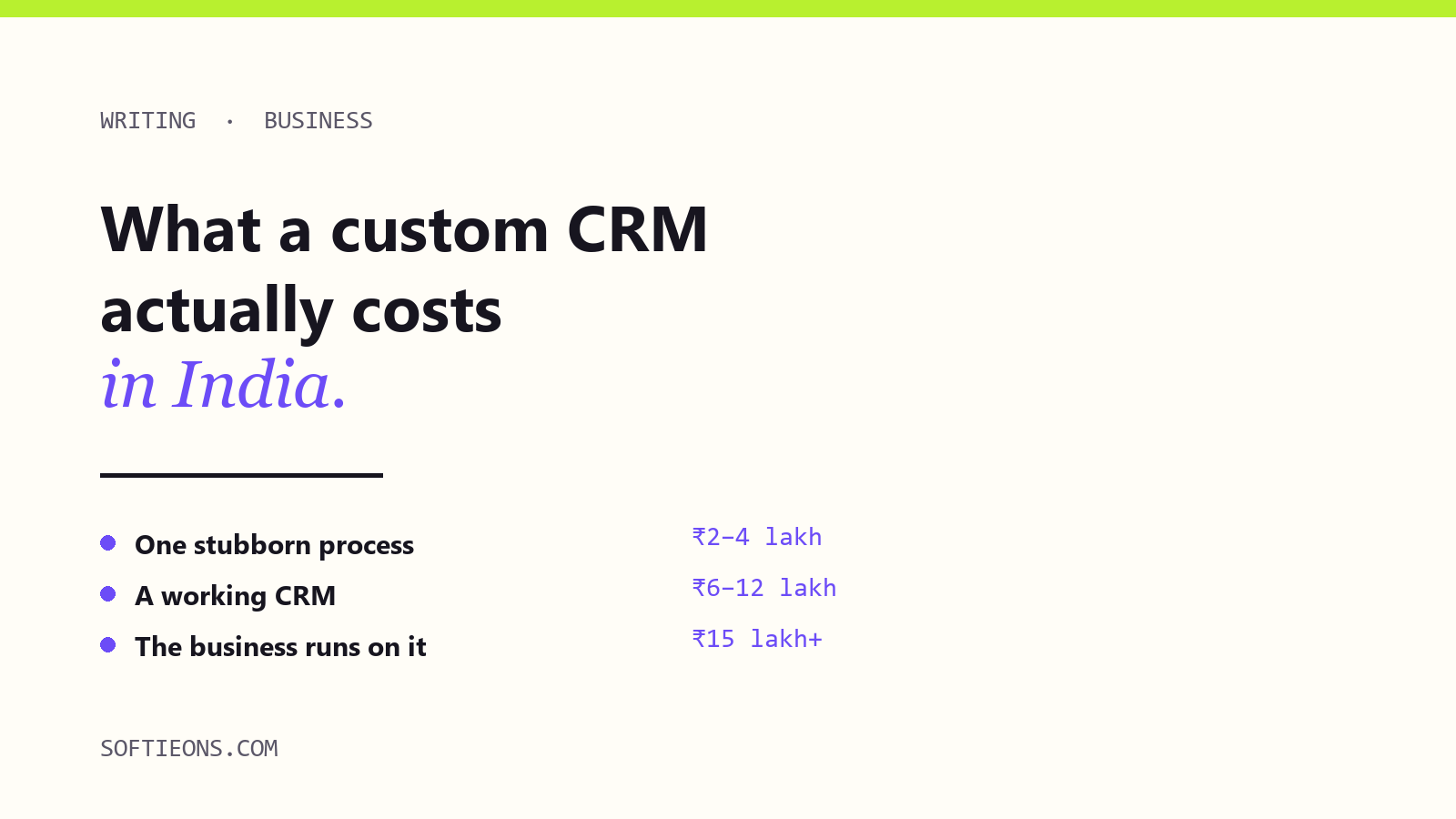
| One stubborn process | ₹2–4 lakh | A single workflow replacing a shared sheet — leads, or inventory, or job cards. Web only, a handful of roles, reports you can export. Six to ten weeks. |
| A working CRM | ₹6–12 lakh | Multiple linked modules, role-based permissions, an audit trail, notifications, dashboards, and usually a mobile app for whoever works in the field. Three to five months. |
| The business runs on it | ₹15 lakh+ | Accounting or payment integrations, multi-branch, document generation, migration of years of existing data, staged rollout with training. Five months and up. |
Ranges exclude GST. A licensed product — Residieons, Accountieons, Shipieons — sits below all three, because the build already happened on somebody else's budget.
3. What actually drives the number up
Not screens. Screens are cheap. These are the five things that move a quote, roughly in order of how much they move it:
- Integrations with things you do not control. Tally, a payment gateway, courier APIs, a government portal. Each one is a dependency with its own downtime and its own surprises. This is the single largest multiplier on a quote.
- Migrating existing data. Years of spreadsheets with inconsistent names, duplicate customers and dates in three formats. Cleaning is often a bigger job than building the screen that displays it.
- Roles and permissions. "Everyone sees everything" is cheap. Branch managers seeing only their branch, and brokers seeing only their own leads, is real design work with real testing.
- A mobile app on top. Field work usually needs one, and it is a second build — offline tolerance, camera, location, and store review cycles. Budget it as its own line, not a feature.
- An undecided process. If three people in your business describe the workflow differently, we are being paid to run the meeting that settles it. That is legitimate work — but it belongs in the estimate honestly.
4. The running costs nobody quotes
A build price is not a total cost. Budget for these separately, every year, or the system quietly rots:
- Hosting and backups. Modest for most CRMs — but the backup you never tested is not a backup.
- Third-party costs that scale with you. WhatsApp conversations, SMS, payment gateway fees, courier APIs. These are per-use and belong in your unit economics, not your project budget.
- Change, not maintenance. The first year after launch always contains changes, because you learn things once real data is in it.
- Someone who owns it internally. Not a developer — a person whose job includes deciding how the system should behave. Systems without an internal owner drift back to spreadsheets within a year.
The most expensive CRM is the one that gets built correctly and then is not used, because nobody agreed what the process was before development started.
5. Buy, license or build
Three routes, and you are really choosing which regret you prefer:
- Off-the-shelf SaaS is cheapest to start and fits worst. You will bend your process to it, and per-user pricing punishes you exactly when you grow.
- Licensing a studio product is the middle road. Someone else paid for the build; you get it in weeks and accept that 10% of it will never be exactly what you wanted.
- A bespoke build fits perfectly and costs the most up front. Worth it when the process is the business — unit inventory for a developer, quotations for a travel desk.
Four of our five products exist because a bespoke build turned out to be the right answer for one client and then obviously reusable for others.
What to do before you ask anyone for a quote
Write down, in one page: who touches a record, in what order, and what decision each person makes. If you cannot write it, no amount of budget will fix it — and any quote you receive is a guess.
Then name the single mistake the software must stop happening. One. If we cannot tie a feature back to that sentence, it should be in phase two.
Send the one-page process. We will tell you if you need a build.
Including when the answer is "you do not". We have talked people out of projects before and would rather do it in the first email than in month three.
If your problem is real estate, travel, GST invoicing, shipping or WhatsApp — a licensed product may skip the build entirely.